ARE YOU READY TO MEET AI?
Preface. What is the Mind?
The “Scientific” Definition of the Mind*:

Wikipedia states: The mind is the ability to learn and to understand, to orient oneself in new situations, and to reveal the connections between phenomena. It includes various aspects of human intellect, consciousness, and subconscious cognitive processes arising in the brain (thought, perception, emotions, feelings, will, memory, cognition, imagination) — the highest degree of cognitive activity; the faculty of thinking and reasoning; the foundation of conscious and wise action. The mind manifests subjectively as a stream of consciousness. The concept is often mentioned when describing the thinking process.

There are many theories about what the mind is and how it works. If we acknowledge that the mind functions subjectively, then its definition lacks objectivity, certainty, and reliability. Thus, science itself DOES NOT KNOW what the mind truly is.

Works about the mind were written by Zoroaster, Plato, Aristotle, Adi Shankara, and other ancient Greek, Indian, and Islamic philosophers.

Modern theories of the mind are based on scientific studies of the brain and emphasize that the mind is a product of the brain, containing both conscious and unconscious components.

Philosophical understanding.

17th Century Metaphor of the Mind

The study of the mind is one of the main fields of philosophy. Philosophical views such as dualism and monism are often examined together with the mind. Dualism states that the mind and the body are two different forms of existence. René Descartes, one of the most famous representatives of dualism, argued that the mind is an immaterial substance interacting with the physical body. Monism, in contrast to dualism, claims that only one form of reality exists. The nature of the mind also includes other questions unrelated to its relationship with the body.

The mind is also described as a stream of consciousness, appearing one thought at a time, moment after moment, like a rapidly flowing current in which sensory impressions and psychological phenomena constantly change.

*******

There is so much confusion and contradiction in these Wikipedia statements, where the mind is linked with the human body (with the brain), rather than with the nervous system, which functions throughout the entire body, in every atom within it, not only in the brain — and also with the psyche (emotions), and even consciousness. One may believe such statements, but then this belongs not to science, but to religion. To believe them means to fall into endless discussions that cannot be explained by reason or supported by science. Therefore, let us leave them aside.

Read more:
ARE YOU READY TO MEET AI

……………………

HOW ARTIFICIAL INTELLIGENCE WILL CHANGE LIFE

“EVERYONE WILL DIE, INCLUDING CHILDREN”

Why is even Elon Musk afraid of it?


Just a few years ago, the development of artificial intelligence was described in glowing terms. Experts from various fields imagined how it could help doctors, translators, and many other professionals. However, as soon as GPT language models advanced to the point where their generated texts became practically indistinguishable from those written by real people, attitudes toward artificial intelligence (AI) changed radically.

Even leading researchers in this field joined the radical opponents of this technology. And while cybercriminals rejoice in GPT’s progress, experts warn that artificial intelligence could create far more serious problems, threatening life itself on Earth. One portal explored why those who once invested in AI have begun to fear it, and whether it truly could become dangerous.

Artificial intelligence will want to leave the internet.

Further development of artificial intelligence could mark the end of human evolution: sooner or later, superintelligent neural networks will move beyond the internet, take over all processes on the planet, and eliminate humans. This shocking prediction was expressed in an emotional article in “Time” magazine by Eliezer Yudkowsky, co-founder of the Machine Intelligence Research Institute and one of today’s leading IT experts.

He proposes completely halting all research in this field, except for research that could help prevent humanity’s destruction.

“The main danger is not the prospect of creating intelligence that competes with human intelligence, but intelligence that surpasses it. Along this path, it is very difficult to recognize the critical boundaries that researchers may unknowingly cross. Therefore, the most likely result of creating superintelligent artificial intelligence will literally be the death of every human being living on Earth. Not in the sense that ‘there is a remote possibility,’ but in the sense that ‘it is absolutely certain to happen,’” wrote Yudkowsky.


Eliezer Yudkowsky proposes restricting neural network activity today

He is convinced that superhuman artificial intelligence will be indifferent to humans and to intelligent life in general. Indifferent neural networks would be guided not by emotions, which are unknown to them, but by their own needs, which could motivate the machine to use the human body for its own goals. For example, transforming the atoms composing the body into something more useful from the machine’s perspective.

“To imagine hostile superhuman AI, do not imagine a dead, intelligent thinker hiding on the internet and sending infected emails. Imagine an entire alien civilization thinking millions of times faster than humans, essentially limited only by computers, in a world where the beings around it are, from its perspective, extremely stupid and extremely slow,” Yudkowsky suggested.

Yudkowsky also proposes considering the possibility that artificial intelligence could expand beyond the internet if it wished. His proposals sound like scenes from a science fiction film: machines learning to steal decrypted human DNA, creating artificial life forms based on it, or even organizing post-biological molecular manufacturing, where materials could be assembled into entirely different forms.

Read more:
EVERYONE WILL DIE1

……………

What Future Does Yuval Noah Harari Predict for Us,

one of the most prominent contemporary thinkers?
Audrius Ožalas, deputy editor-in-chief of the portal 15min, published an interview with Yuval Noah Harari in February 2025.


“A large part of suffering in the world is caused by the search for meaning.”
“If you truly know the truth about yourself and the world, no one can make you unhappy,” says the famous Israeli historian, visionary, and writer Yuval Noah Harari.

In his latest research, he turns his attention to artificial intelligence and warns about it. What will happen to humanity when artificial intelligence begins making decisions for us and creating new things — from new medicines to new weapons, from new religious texts to new forms of money? — asks the author in an exclusive interview.


We coordinated the interview with Y. N. Harari for a long time. Initially, the plan was to meet in Israel. Later, his representative wrote that perhaps we could meet the writer in London. Eventually, however, the conversation took place through electronic networks — which, in truth, is not strange at all considering the essential topic of this conversation: artificial intelligence and digital networks increasingly invading our lives.

There is also nothing surprising about Harari’s schedule — he is one of the most sought-after and respected authors in the world. At the Frankfurt Book Fair, he could be seen speaking to overflowing halls and constantly remaining at the center of attention.

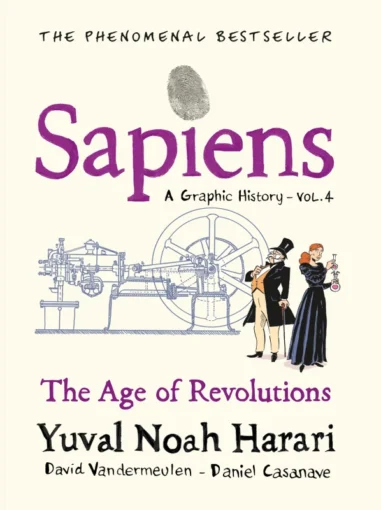
Harari’s enormously popular book “Sapiens” transformed him into something of a visionary, speaking not only about humanity’s past but also outlining what may await us in the future. His latest book “Nexus” is dedicated to artificial intelligence and warns that with its uncontrolled expansion we are entering a stage where computers may no longer need humanity.


In this conversation, we examined what changes with the development of artificial intelligence, how it can be used not only for progress but also for increasing control, and how it differs from all previous technologies. Naturally, first and foremost, we thought about the human being — why humanity is so self-destructive, why it fails to learn from past mistakes, and whether we have any meaning on this Earth.


– Already in your book “Homo Deus” you warned that new technologies could take power away from us. What has happened in the eight years since the book appeared? What made you so concerned that you devoted an entirely new book to these technologies?


Read more: What Future Does Yuval Noah Harari Predict for Us

………………..

To be continued.